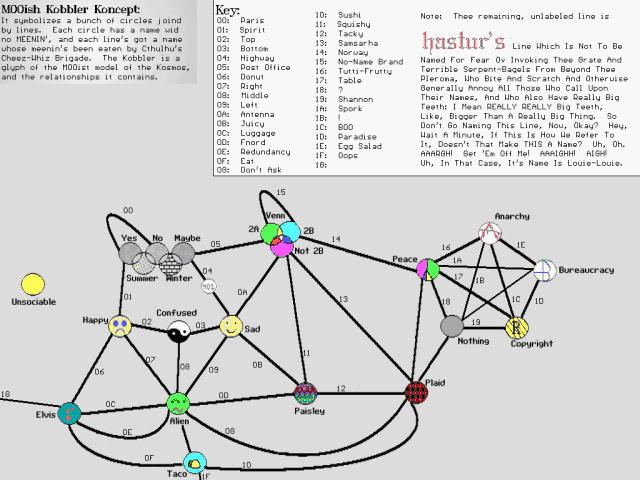
With the twelfth MOO-Cow Gamma proclamation, we come to the Konfuse-Ius Kreation known as the MOOish Kobbler Koncept. This bizarre diagram and obscure note first appeared as a Confuse-Ing Inter-Rapture in The Last Will And Tasty-Mint of the Illustrious Zoombart The Fifth. It consists of "a bunch of circles joined together by lines. Each circle has a name, which is meaningless. Each line also has a name, which has a meaning, but nobody knows what it is." Only recently has it been discovered that the Pure Fool Confuse-Ius discovered, in this joke, the true structure of the MOOist universe.
The Kobbler Koncept diagram is loosely connected to the Jewish Kabbalah and its diagram, the Tree Of Life. It may be found in the Book Of MOO between Preface 7 and Preface 9 1/2.
The diagram consists of 22 circles labeled Yes, No, Maybe, Summer, Winter, 2A, 2B, Not 2B, Peace, Anarchy, Bureaucracy, Copyright, Nothing, Plaid, Paisley, Happy, Sad, Confused, Alien, Elvis, Taco, and Unsociable. There is also another circle on one of the lines. The line labelled "Highway" has a circle containing the number 401. This "virtual" node, called 401, is of great Kabbalistic significance, as we shall see later. There are four groupings of nodes, labelled Pentagon, MOO, Venn, and Olympic.
The original Confuse-Ius diagram is incomplete in a number of ways. First, the group Pentagon should have a line connecting each node in that group to each other. The node labelled "Nothing" is more accurately labelled "Void". The group "MOO" is not labeled on the diagram (it consists of Happy, Sad, Confused, and Alien). The names given the lines on the original diagram are NOT the actual names of the lines, as known to the Ancient Atlantean Adepts of MOO, but are actually misdirection by Confuse-Ius. Also, there should be seven arcs surrounding the diagram. These are discussed later.
Why do we claim that this diagram has connections to the Jewish Kabbalah when it's obviously a creation of Confuse-Ius, devoid of meaning, and at best a poor satire of an ancient and respected system? Is it just because we're annoying bastards, or is there a better reason? Serious Kabbalists want to know.
Robert Wang, in "The Qabalistic Tarot", says that the Kabbalah is a useful mystical system only as far as it points beyond itself. The nature of truth is infinite, incapable of any finite expression (this is a mathematically certain fact), and in fact, incapable of any expression, finite or infinite.
The Kabbalah does this admirably by means of of the En Sof, the three veils of negative existence, and the unmanifest side of Kether, indicating an incomprehensible existence beyond the structure of sephiroth it describes. All fine and dandy, but it leaves one with the impression that these things, though real, are fundamentally unknowable. The Kabbalah is a growing and dynamic system, which points beyond itself.
The Kobbler is also changing and dynamic, and points to realities beyond its own description. The structure of the two may be quite different, but when considered together, they can offer insights into the nature of the Absolute.
Of course, they can confuse the living bejeezus out of the seeker as well. But Confuse-Ius takes no responsibility for those who aren't able to deal with his trickery. Maya can be a devious monster, but it's all we have to learn from, in its various forms.
From the point of view of the Kabbalah, the Kobbler is either one of the delusional forms of illusion which keep us rooted in Malkuth (the World), or an hallucination of the kind which haunts those who try to cross the Abyss (where Da'ath lives, more on which later) or one of the "Kingdoms Of Edom", fundamentally different structures which reside somewhere beyond the veils of negative existence. Falsely called "failed creations", they are just alternate structures in the structureless Absolute, compared to which the structure of theSephiroth itself is a delusion of maya.
On a higher level, these explanations are really the same. Kether and Malkuth merge as the complexity of Malkuth becomes the simplicity of Kether. Da'ath is a hole in the Abyss which leads into the En Sof.
Anyway, fuck that. On with the Kobbler.
The Kobbler, in its most elementary form, is a representation of interrelationships, a kind of composite glyph of how the world works. While the Kabbalah has a heirarchical structure, the Kobbler is closer to the Indra's Web metaphor of the Hindus, in which the world is composed of an inter-related network of points, each one of which contains a reflection of every other one, every other reflection, and so forth. The entire infinite structure is contained in every point.
The Kobbler diagram contains a variety of possible relationships, from close to distant, in various forms. It would be impossible here to elaborate on all of them, but we point out a few.
There is the Pentagon, in which five nodes enjoy every possible connection from any one to any other. This represents a holisitic paradigm.
There is the Venn group in which three nodes interpenetrate, so that every possible overlap between the three is realized, and yet there is a line connecting 2A and 2B despite their interpenetration. This represents the dual esoteric and exoteric nature of many relationships.
There is the Olympic group in which a chain of interpenetrating nodes exists, but not all nodes interpenetrate with all others. There is a path connecting two non-interpenetrating nodes which are joined by a shared node as well as a path. This indicates that there may be HIDDEN relationships of a very deep nature between events which have obvious logical connections.
There is the case of the two paths connecting "Elvis" and "Alien", indicating the possibility of many levels of relationship between two events.
There is the "Unsociable" node, which has no lines connecting it with any other node, thus appearing to be unconnected. On a higher level, however, it is connected to the nodes in that it shares their structure: it is a node, has a name, etc. This represents a higher level of abstraction in a relationship between events than that which immediately meets the eye.
The "virtual" node, 401, does not even share the high-level relationship with the other nodes that Unsociable has. It has confused itself with the path labelled "HIGHWAY". However, since it represents the very act of being associated, it in some way is connected with all of them, but at a higher level than Unsociable.
Recall that the diagram should be surrounded by seven arcs. These represent, in order, a point, a circle, an ellipse, a parabola, a hyperbola, a pair of lines, and a negative space. The diagram of nodes and lines is considered nestled INSIDE the point. The "Unsociable" node is inside the circle but outside the point, while the virtual node, "401" is considered to be outside the circle but inside the ellipse: it is a connection straight from the diagram to beyond the second veil of negative existence.
These veils can be drawn concentrically, and the geometrically inclined will notice that there should be mirror-image reflections of everything inside the seventh arc (a negative space) since the line pair, the sixth arc, is its own mirror image. Thus, inside the mirror-image point is an opposite but corresponding structure to the Kobbler diagram. This is known as the Klobber, and it consists of exactly opposite information vectors to the "real" world. Its logic is precisely inverted, and its structures are inverted. Since the Kobbler is a glyph of the "real" world, the Klobber is a glyph of its logical opposite, not an anti-matter world, but an anti-logic world. This could be discussed at great length, but this is not the place for lengthy blather.
It will be noted that in this form of the diagram, the 7th veil cannot be drawn. The seventh veil is not the "last", but it is the last whose interior can be described in terms of what is inside the Kobbler Koncept. The interiors of the seven veils are described, in order, as: Suchness; Detachment; Ambuiguity; Divinity; Transcendence; Inaccessibility; Extensibility.
Suchness refers to the Kobbler itself, the world as it operates. Its number is 0.
Detachment refers to a separation from the world while within it. Its number is 1.
Ambiguity refers to the possibility of the existence of other logical structures to the same universe. Its number is 2. The virtual node, "401", exists in this realm, and is joined to the Kabbalistic "Daath", which connects the sephiroth in the Kabbalah to the Beyond, much as "401" does in the Kobbler.
Divinity refers to moving beyond all finite descriptions of the universe to a higher reality. Its number is omega, the first infinite number.
Transcendence refers to a stage beyond divinity, beyond the conceivable, all stages of "higher reality" and all possible relationships between them, and towards another kind of truth. Its number is aleph-one, the second infinite number.
Inaccessibility refers a level of "higher reality" which is inaccessible from below, and can only be understood from its own point of view. Its number is theta, the first "inaccessible cardinal" in transfinite set theory.
Extensibility refers to the fact that the Absolute can never be exhausted. It points to levels beyond itself. Its number is kappa, the first "measurable cardinal" in set theory. The measurable cardinals are interesting because they point to the incompleteness of our understanding of the finite: they suggest that there are many more possibilities to the merely finite than we can consciously grasp.
What is symbolized by the invisibility of the 7th veil is that nothing beyond the 7th veil is comprehensible to a finite mind, but there is an infinite series of veils, an Absolutely Infinite structure to the Absolute.
It's true that the Kobbler Koncept was created by Confuse-Ius as a diversionary tactic, part of the Guerilla Ontology which underlies MOOism, but in a way, the Kobbler is a more accurate, broader, and more complete picture of the universe than any other which has ever existed.
This is because it is not, and is not intended to be, taken seriously. It is only a PICTURE of the world, a glyph, or image, and it incorporates that fact into itself. This is what sets MOOism apart from other religions. We are better, in a way, by virtue of the fact that we make no claims to completeness, to correctness. We are growing and dynamic. The Kobbler Koncept as originally created was taken, illuminated, and grew to become a better and more complete idea of truth.
What is presented here is by no means all that could be said on the Kobbler. The deep connections between abstruse concepts in the Kabbalah, transfinite set theory, information theory, quantum physics, gymnastics, pole-vault, and pin-the-tail-on-the-donkey are far too numerous to discuss, and to do so would violate the idea that it is growing and dynamic. You can take it, believe in it, throw it away, or do anything else with it you like (except using it as toilet tissue, which is against the Seventh Commandment of MOO), and it will only succeed if it allows you to grow beyond needing it as a crutch.
The Carrot Deck, described in MOO-Cow Gamma-1, was created from the concepts in the Kobbler diagram, and can be used as a fruitful tool of meditation for anyone who decides to take the Kobbler seriously. This is no more and no less stupid than taking the Kabbalah seriously, or for that matter any other occult system, religion, political philosophy, or other mindset.
In fact, the development of the mind is furthered by being able to seriously consider the consequences of the apparently ridiculous. Even if the Kobbler is NOT the "truth", whatever actually is will almost certainly seem equally stupid on first sight. To find a truth we can live with, we must be able to seriously consider the downright stupid. I heartily recommend meditation on the Kobbler.
Here's the thing. "Illumination", as in, mystical enlightenment, is a good metaphor. It's a kind of light that shines into your mind. If there's no ideas there for it to shine on, you don't see anything except a kind of blinding light. It might feel good, and look pretty, but you don't really get anything out of it. But no matter what the structure you put in your mind for it to shine on, you get the same benefits of seeing your ideas clearly, without fumbling around in the dark, searching for something to believe in. The Kobbler is no worse than any other system, and may be even better, because it won't lead to dogmatism.
This is just information to assimilate. You make up your own mind.